Trenchless Pipe Repair vs Traditional Methods for Texas Soil: The Complete 2026 Guide
Reading time: 14 minutes
Imagine this: You wake up to soggy ground in your backyard, a suspicious wet patch creeping toward your foundation, and a plumber telling you your sewer line needs replacement. Now comes the real gut punch — the estimate. In Texas, where the soil is as unpredictable as the weather, the method you choose for pipe repair can mean the difference between a manageable repair bill and a full-scale landscape demolition project costing tens of thousands of dollars.
Whether you’re a homeowner in Houston’s clay-heavy suburbs, a property manager in Austin’s limestone terrain, or a contractor navigating the expansive soils of the Dallas-Fort Worth metroplex, understanding the interplay between pipe repair methods and Texas soil conditions is genuinely critical. This isn’t just about choosing a trendy technology — it’s about making a smart, soil-informed decision that protects your investment for decades.
Well, here’s the straight talk: Texas soil doesn’t play nice with pipes, and it definitely doesn’t play nice with cheap shortcuts. Let’s break down everything you need to know.
Table of Contents
- Why Texas Soil Is a Pipe’s Worst Enemy
- Traditional Open-Cut Methods: What You’re Actually Getting
- Trenchless Technologies: The Modern Arsenal
- Head-to-Head Comparison: Metrics That Matter
- Real Texas Scenarios: Case Studies from the Field
- Cost & Disruption: Visual Data Breakdown
- 3 Common Challenges and How to Overcome Them
- How to Choose the Right Method for Your Property
- Frequently Asked Questions
- Your Pipe Repair Decision Roadmap
Why Texas Soil Is a Pipe’s Worst Enemy
Texas isn’t just big — it’s geologically complex. The state spans at least six distinct soil types, each presenting unique challenges for buried infrastructure. Before you can intelligently choose between trenchless and traditional methods, you need to understand what you’re working with underground.
The Big Three Texas Soil Problems
1. Expansive Clay (Houston, DFW, San Antonio)
Expansive clay soils — particularly the notorious Houston Black Clay and Blackland Prairie soils across central and north Texas — are arguably the most damaging soil type for pipe infrastructure in the United States. These soils can expand up to 30% in volume when wet and shrink dramatically during droughts. According to the Texas A&M AgriLife Extension Service, expansive soils are responsible for more structural damage to residential properties in Texas than all natural disasters combined — a figure that remains staggering in 2026.
For pipes, this means constant lateral pressure, joint displacement, and in older cast iron or clay pipes, catastrophic cracking. The Texas drought cycles of 2022-2024 followed by the heavy precipitation events of 2025 created what geotechnical engineers now call “accordion effect” on buried pipes — repeated expansion and contraction that accelerates failure timelines by 40-60% compared to stable soil environments.
2. Limestone Karst (Austin, Central Texas Hill Country)
In Austin and the Hill Country, contractors are often drilling into solid limestone within 12 to 24 inches of the surface. Traditional trenching in karst terrain requires jackhammering and specialized excavation equipment, dramatically increasing both cost and project duration. The fractured nature of karst limestone also creates unpredictable void spaces — pockets where pipes can settle unevenly over time.
3. Sandy Loam & Coastal Soils (Gulf Coast Region)
Along the Gulf Coast — from Corpus Christi to Beaumont — sandy loam and coastal sediment soils present a different problem: poor compaction and high water table levels. Open trenches in these environments frequently require dewatering operations, and trench walls can collapse without continuous shoring. In post-Hurricane Beryl recovery zones (2025), many coastal Texas municipalities discovered that traditional repair methods became logistically impossible in saturated soil conditions.
Freeze-Thaw Cycles: An Emerging Texas Concern
Historically, Texas wasn’t considered a freeze-thaw climate. The Winter Storm Uri disaster of 2021 changed that perception permanently. Since 2021, Texas building codes have been updated to recognize intermittent freeze-thaw cycles as legitimate soil stress factors. In 2025, the Texas Water Development Board reported that municipalities spending on pipe rehabilitation increased by 23% year-over-year, partly attributed to infrastructure damage from the 2024 winter freeze events in North Texas. This new climatic reality adds urgency to choosing repair methods that can withstand soil movement from unexpected temperature drops.
Traditional Open-Cut Methods: What You’re Actually Getting
Traditional pipe repair — often called open-cut excavation or cut-and-replace — has been the industry standard for well over a century. It’s straightforward, widely understood, and universally available. But in Texas soil conditions, the method carries a specific set of trade-offs that deserve honest examination.
How Open-Cut Works
The process is exactly what it sounds like: excavators dig a trench from the surface down to the damaged pipe, remove and replace the failed section, backfill the trench, and restore the surface. For residential sewer lines, this typically means digging a trench 4-8 feet deep and anywhere from 10 to 150 feet long, depending on the extent of damage.
Key steps in traditional open-cut repair:
- Site assessment and utility marking (mandatory in Texas under the 811 Dig Safe program)
- Surface removal — concrete, asphalt, landscaping, or hardscaping
- Excavation to pipe depth with shoring installation for safety
- Pipe removal and replacement with new PVC or HDPE piping
- Backfilling and compaction (critical in expansive clay environments)
- Surface restoration
The Hidden Costs in Texas Conditions
On paper, open-cut repair often appears cheaper at first quote. In practice, Texas soil conditions reliably generate cost overruns. Expansive clay backfill is notoriously difficult to properly compact — improper compaction leads to differential settling, which can damage the very pipe you just replaced within 5-7 years. Many Texas contractors now require imported granular backfill material specifically to avoid using native clay as backfill, adding $8-$15 per linear foot to project costs.
In Austin’s limestone terrain, open-cut excavation regularly encounters rock that requires pneumatic breaking, adding $20-$45 per linear foot in equipment and labor costs that rarely appear in initial estimates. In 2025, the Austin Water Utility reported that its open-cut rehabilitation projects ran an average of 34% over initial budget due to unexpected rock encounters.
Trenchless Technologies: The Modern Arsenal
Trenchless pipe repair isn’t a single technology — it’s a family of methods that share one core principle: repairing or replacing pipes with minimal surface disruption. In Texas, where surface infrastructure investment is substantial (think mature landscaping, concrete driveways, pool decks, and mature tree root systems), this distinction carries enormous financial value.
Cured-in-Place Pipe Lining (CIPP)
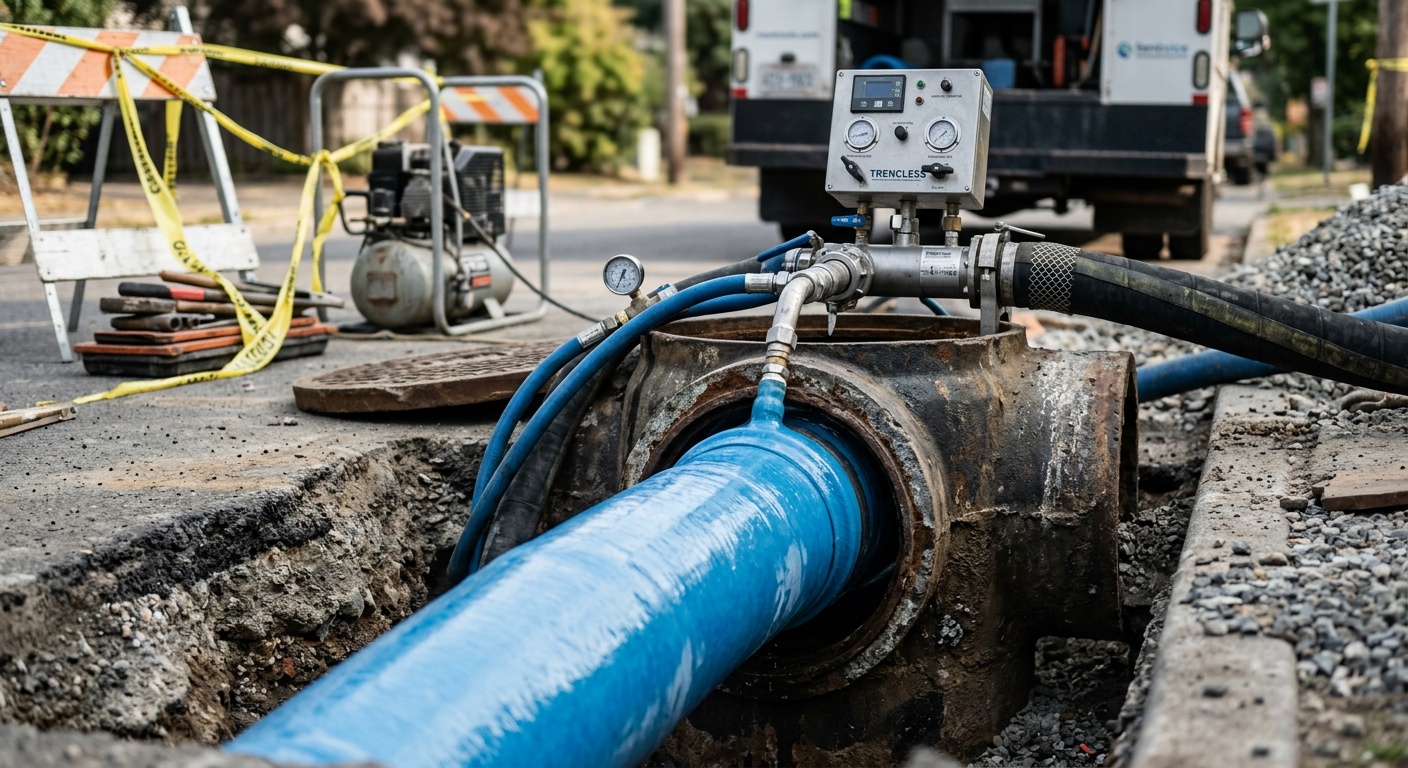
CIPP — sometimes called “pipe lining” — involves inserting a resin-saturated felt tube into the damaged pipe, inflating it against the existing pipe walls, and curing it in place using UV light or steam. The result is a new, jointless pipe within the old pipe. The technology has been commercially available since the 1970s but has undergone dramatic improvements in resin chemistry and installation speed through 2025.
CIPP is particularly well-suited to Texas conditions because:
- It creates a flexible, seamless liner that can tolerate modest soil movement from clay expansion
- Access requires only small entry and exit pits — typically 2×2 feet
- It works effectively in pipes from 4 to 96 inches in diameter
- Modern UV-cured CIPP systems can complete residential installations in 4-8 hours
- The liner creates a slightly reduced pipe diameter (typically 3-5mm) but hydraulic performance is often improved due to the smoother interior surface
In 2026, CIPP costs in Texas range from $80 to $250 per linear foot for residential applications, with variance driven primarily by pipe diameter, depth, and regional labor markets.
Pipe Bursting
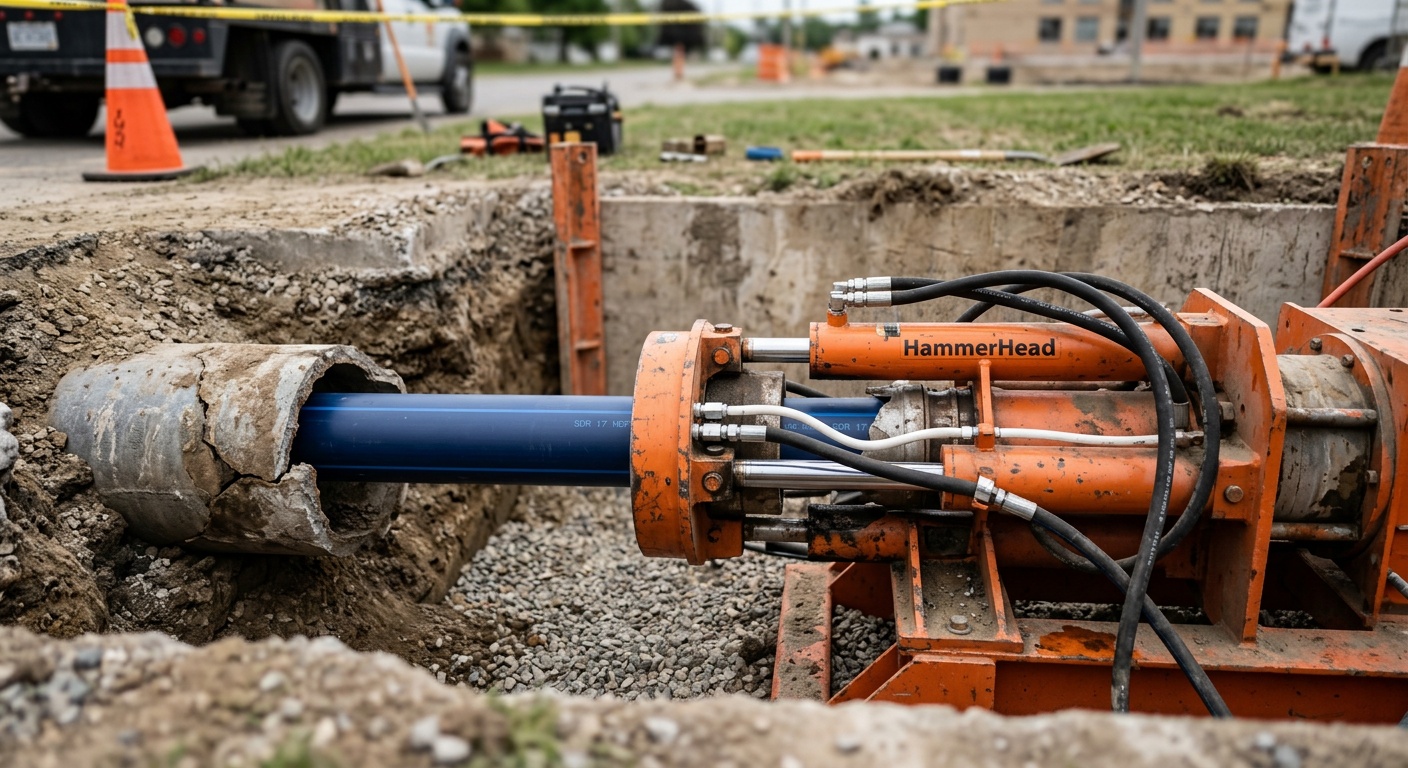
Pipe bursting is the trenchless method of choice when a pipe is too damaged for lining or needs to be upsized. A hydraulically or pneumatically driven bursting head is pulled through the existing pipe, fracturing it outward into the surrounding soil while simultaneously pulling a new HDPE pipe into position behind it.
In Texas clay soils, pipe bursting has a nuanced performance profile. The displaced soil from the burst pipe must go somewhere — in expansive clay, this can actually improve soil compaction around the new pipe in some conditions. However, in areas with shallow utilities running parallel to the target pipe, the soil displacement can cause unintended movement. Ground probing radar surveys are now considered standard practice before any pipe bursting project in densely developed Texas urban areas.
Directional Drilling (HDD)
Horizontal Directional Drilling is primarily used for new pipe installations rather than repairs, but it’s increasingly being deployed for pipe replacements in scenarios where the existing pipe route must be entirely abandoned. HDD allows contractors to drill a new path underground — avoiding existing infrastructure, tree roots, and surface features — and pull new pipe through the bored pathway.
In Austin’s limestone terrain, HDD presents specific equipment challenges. The drill bits and mud systems must be engineered for hard rock formations, which adds cost but remains faster and less disruptive than open-cut rock excavation in most scenarios.
Spray Lining and Structural Pipe Coating
For smaller-diameter water supply pipes (typically 2-6 inches), spray lining applies a centrifugally sprayed epoxy or cementitious mortar coating to the interior pipe walls. This method is particularly valuable for rehabilitating galvanized steel and copper water supply lines in older Texas homes where pinhole corrosion is the primary failure mode. Costs typically run $25-$65 per linear foot, making it the most economical trenchless option for appropriate applications.
Head-to-Head Comparison: Metrics That Matter
| Metric | Traditional Open-Cut | CIPP Lining | Pipe Bursting |
|---|---|---|---|
| Avg. Cost (per linear ft, Texas 2026) | $50–$180 | $80–$250 | $60–$200 |
| Project Duration (residential) | 2–5 days | 1–2 days | 1–3 days |
| Expected Lifespan of Repair | 25–50 years | 50+ years | 50–100 years (HDPE) |
| Surface Restoration Required | Extensive | Minimal | Minimal |
| Performance in Texas Clay Soil | Moderate (backfill risk) | Excellent | Good–Excellent |
Real Texas Scenarios: Case Studies from the Field
Case Study 1: Houston Heights — The $47,000 Difference
In late 2025, a homeowner in the Houston Heights neighborhood discovered a collapsed 6-inch clay sewer main running 85 feet from the house to the city connection — a common finding in homes built in the 1940s-1960s era. Two contractors provided quotes: the first, using traditional open-cut methods, quoted $28,500 for pipe replacement but did not include the cost of removing and restoring a mature 30-inch live oak tree’s root zone, a concrete driveway, and a recently installed paver walkway. When restoration costs were fully itemized, the total climbed to $51,200.
The second contractor, specializing in CIPP rehabilitation, quoted $18,700 all-in — including a full CCTV inspection, pipe cleaning, liner installation, and two small access point restorations. The homeowner chose CIPP, completed the project in a day and a half, and saved over $32,000 in total project cost. The live oak — appraised at $22,000 in canopy value — remained undisturbed.
Case Study 2: Plano Municipal Water Main — Speed Under Pressure
In March 2026, the City of Plano faced an emergency repair situation on a 12-inch water transmission main running beneath a major commercial corridor. The main, installed in 1988 in expansive clay soil, had developed a significant structural crack causing pressure loss across a 3-mile service area. Traditional open-cut repair would have required closing a four-lane road for an estimated 11 business days and coordinating with TXDOT for traffic management — with an estimated economic impact to adjacent businesses of $340,000.
The city’s infrastructure team authorized an emergency CIPP rehabilitation. Using a 12-inch UV-cured liner system, the repair was completed with the road restricted to single-lane operation for 38 hours. Total project cost was $187,000 versus an open-cut estimate of $142,000 — the $45,000 premium representing excellent value when weighed against traffic management costs, business disruption claims, and the economic impact estimate.
Case Study 3: San Antonio’s Karst Challenge — Pipe Bursting Through Limestone
A residential community in San Antonio’s Stone Oak area experienced widespread sewer failures in a development built over fractured limestone karst terrain. The development’s 1990s-era PVC pipes had settled unevenly due to karst void migration, creating multiple belly formations and joint separations across 2,200 linear feet of lateral lines.
The homeowners association considered traditional open-cut, which would have required jackhammering through 18-24 inches of limestone across numerous properties — with estimates ranging from $380,000 to $490,000. A pipe bursting contractor proposed a hybrid approach: CIPP lining for sections with adequate pipe integrity, and pipe bursting for severely damaged sections. The hybrid trenchless solution was completed for $267,000, saving the HOA over $110,000 while completing the project 60% faster than open-cut estimates.
Cost & Disruption: Visual Data Breakdown
Total Cost Index for 100-Foot Residential Sewer Repair in Texas (2026)
Index includes direct repair costs + surface restoration + landscaping restoration estimates
3 Common Challenges and How to Overcome Them
Challenge 1: “My Contractor Says Trenchless Won’t Work Here”
This is the most common pushback homeowners encounter — and while it’s sometimes legitimate, it’s also occasionally a reflection of a contractor’s equipment limitations rather than genuine site constraints. Trenchless methods do have real limitations: pipes with multiple 90-degree bends may complicate CIPP liner installation; severely offset joints may require point repairs before lining; and pipe bursting in soils with parallel utilities less than 18 inches away carries risk.
How to overcome it: Request a CCTV (closed-circuit television) pipe inspection report before accepting any diagnosis. A video inspection costing $150-$350 will definitively show pipe condition, bend configurations, and offset joints. Then get a second quote from a contractor who specializes specifically in trenchless methods — not a general plumber who offers it as a secondary service. In Texas, the Texas Rooter and Trenchless Association (an industry body formed in 2023) maintains a contractor directory organized by specialization.
Challenge 2: Navigating Texas Permitting for Trenchless Work
Permitting requirements for trenchless pipe repair vary significantly across Texas municipalities. In Houston, CIPP lining on residential laterals typically requires only a standard plumbing permit. In Austin, work within the Edwards Aquifer Recharge Zone (which covers significant portions of the city) requires environmental review documentation regardless of method. In Dallas, work in public rights-of-way — even trenchless work — requires coordination with the Dallas Department of Public Works.
How to overcome it: Always verify permitting requirements with your city’s building department before signing a contract. Legitimate contractors include permit acquisition in their scope of work. Be wary of contractors offering to skip permits as a cost-saving measure — in Texas, unpermitted plumbing work can void your homeowner’s insurance coverage for related water damage claims and complicate property sales.
Challenge 3: Post-Repair Settlement in Expansive Clay
Even perfectly executed pipe repairs can be undermined by Texas clay soil movement in the years following installation. This is a challenge that neither traditional nor trenchless methods fully solve — it’s a site condition management issue. The good news is that trenchless methods, by minimizing soil disturbance, significantly reduce the risk of introducing new settlement pathways.
How to overcome it: After any pipe repair in clay soil environments, address moisture management around the repair zone. This includes maintaining consistent soil moisture levels through foundation watering programs during drought periods (a practice recommended by the Texas Foundation Repair Association), ensuring proper drainage grades away from the repaired area, and scheduling a CCTV re-inspection 2-3 years post-repair. Several Texas municipalities now offer subsidized post-repair inspection programs — check with your water utility.
How to Choose the Right Method for Your Property
The honest answer is: there’s no universal “best method” for Texas pipe repair. The right choice depends on a specific intersection of factors that are unique to your property, your pipe system, and your priorities.
Choose Traditional Open-Cut when:
- The pipe has completely collapsed with no remaining internal structure for a liner to adhere to
- The pipe needs to be significantly relocated (not just replaced in place)
- Access to the pipe is already available due to other excavation work
- The surface above the pipe has no value (undeveloped land, gravel areas)
- Multiple intersecting repairs make a single trench more economical than several trenchless access points
Choose CIPP Lining when:
- The pipe retains enough structural integrity to serve as a liner host
- Valuable surface features (trees, concrete, landscaping, pool deck) are directly above the pipe
- Minimizing project duration is a priority
- The pipe is in an expansive clay zone where future soil movement is expected
- You need a seamless, corrosion-resistant solution for long-term performance
Choose Pipe Bursting when:
- The existing pipe is too damaged for lining but follows a route that can accommodate the method
- You want to upsize the pipe diameter (e.g., from 4-inch to 6-inch)
- The pipe is in sandy or loose soil that accommodates displacement
- There are no parallel utilities within 18-24 inches of the pipe centerline
Pro Tip: In 2026, several Texas plumbing contractors now offer free AI-assisted site assessments that combine CCTV inspection data, soil type mapping, and utility records to generate a method recommendation score. While not a substitute for experienced professional judgment, these tools can help you have a more informed conversation with your contractor.
Frequently Asked Questions
Is trenchless pipe repair always more expensive than traditional methods in Texas?
Not when you account for total project cost. The direct labor and materials cost for trenchless methods sometimes exceeds open-cut pricing on a per-linear-foot basis, but the total project cost — including surface restoration, landscaping repair, and time-value considerations — frequently makes trenchless the more economical option in Texas. In scenarios involving concrete driveways, mature trees, pool decks, or decorative hardscaping, trenchless methods can save $5,000 to $30,000+ in surface restoration costs alone. Always request fully itemized quotes that include all restoration work before comparing prices.
How does Texas’s drought cycle affect the timing of pipe repairs?
Texas’s drought cycles have a direct impact on optimal repair timing. During severe drought conditions, expansive clay soils shrink and pull away from existing pipes, creating lateral voids that can change pipe geometry and affect trenchless liner adherence. Conversely, immediately after heavy rainfall, soils are saturated and difficult to work in for open-cut methods. Most Texas trenchless specialists recommend scheduling non-emergency repairs in the spring (March-May) or fall (September-November) when soil moisture levels are more stable. For emergency repairs, the method choice may be constrained by current conditions — trenchless methods are generally more adaptable to adverse soil moisture states than open-cut excavation.
Can trenchless pipe repair handle tree root intrusion problems in Texas?
Yes, and in fact trenchless rehabilitation often outperforms traditional replacement for root intrusion scenarios in Texas. Before CIPP lining, contractors use mechanical cutting or hydro-jetting to clear root intrusions from the pipe interior. The installed liner then creates a seamless, jointless pipe surface with no gaps for roots to exploit — unlike traditional pipe replacement, which creates new joints at connections that roots will eventually find. In Texas, where live oak and cedar elm root systems can extend 40+ feet from the tree trunk, the seamless nature of CIPP lining is a particular long-term advantage. Many Houston and Austin homeowners with heritage oak trees specifically request CIPP lining to avoid disturbing root systems during the repair process.
Your Pipe Repair Decision Roadmap: From Problem to Solution
Pipe repair decisions in Texas don’t have to feel overwhelming. With the right information and a structured approach, you can move from “soggy yard panic” to “confident decision” in a matter of days. Here’s your action-oriented roadmap:
- Get the CCTV inspection first. Before accepting any contractor’s diagnosis, invest in a video pipe inspection. This $150-$350 expenditure is the single most valuable step you can take — it transforms guesswork into data-driven decision-making and gives you documentation to share with multiple contractors for comparison quotes.
- Know your soil type. Use the USDA Web Soil Survey (websoilsurvey.sc.egov.usda.gov) to identify your specific soil classification. This free tool will tell you whether you’re in an expansive clay zone, a karst limestone area, or a coastal sediment environment — intelligence that directly informs method selection.
- Get three quotes with full itemization. Require every contractor to provide line-item quotes that include surface restoration, permitting fees, and post-repair cleanup. This apples-to-apples comparison will likely reveal significant cost differences that aren’t visible in top-line estimates.
- Verify credentials and Texas-specific experience. Confirm your contractor holds a valid Texas Master Plumber license, carries liability insurance of at least $1 million, and can demonstrate specific experience with your soil type and chosen repair method.
- Plan for the long term. Schedule a CCTV re-inspection 2-3 years after any repair to catch early warning signs before they become emergencies. In Texas clay environments especially, proactive monitoring is far less expensive than reactive emergency repairs.
The broader trend is clear: as Texas infrastructure ages (the state’s average residential sewer lateral is now over 40 years old), the pipe rehabilitation market is growing rapidly. The Texas Water Infrastructure Fund, expanded in 2025’s legislative session, now includes trenchless rehabilitation as an eligible project category for municipal funding — a recognition that these methods deliver better long-term value for Texas’s unique geological conditions.
Here’s the question worth sitting with: When was the last time you had your home’s sewer lateral inspected? For most Texas homeowners, the answer is “never” — and that’s a risk that Texas soil conditions make significantly more consequential than in other parts of the country. Don’t wait for a Sunday morning emergency to start this conversation. Your pipes, your landscaping, and your wallet will thank you for the proactive approach.